Free · South Korea
Can I Have One More? Asking for a Refill or Extra Dish
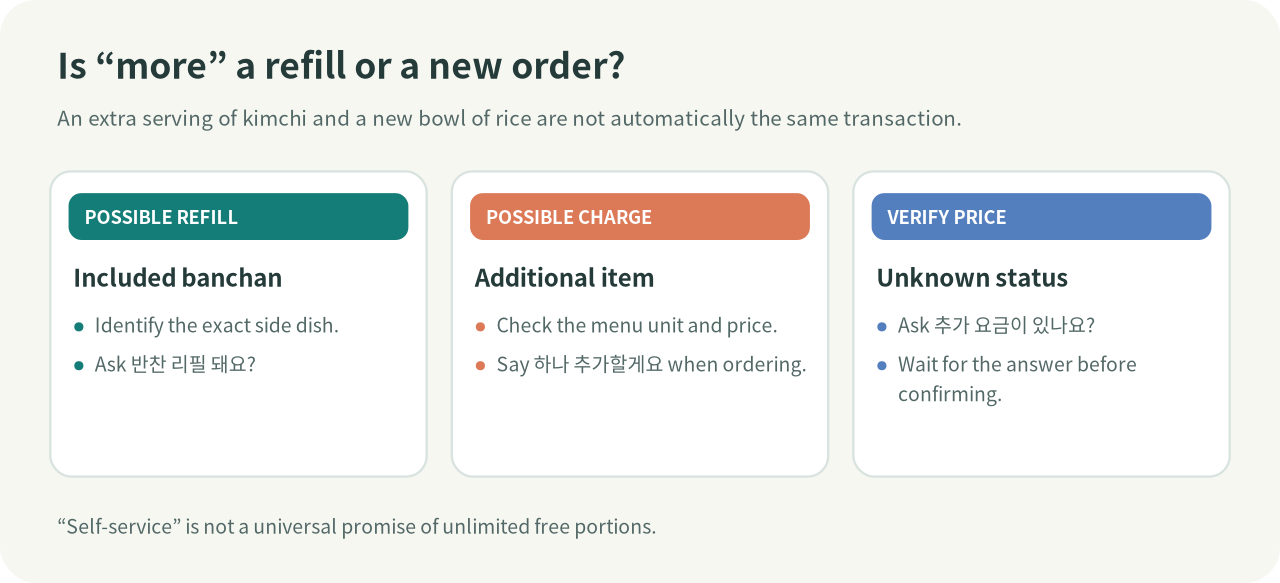
An extra piece of kimchi, another bowl of rice, and a second main dish are not the same request. Learn to ask which kind of “more” you mean—and whether it costs extra.
Your meal has arrived with several small dishes. You finish one of them. Across the room is a self-service counter. Someone at another table asks for 반찬 좀 더 주세요 and receives more food. You might conclude that anything you request a second time is included. That would be a mistake. The practical distinction is between an included side-dish refill, a free but limited self-service item, and a separate paid order.
In many Korean dining settings, 반찬 (banchan) means the small side dishes accompanying a meal. Korea Tourism Organization guidance describes extra side dishes as commonly complimentary and also notes that water and side-dish stations may be self-service. [1] But the arrangement differs by establishment and by item. The same restaurant may refill kimchi without charge while selling an extra bowl of rice, a new portion of meat, or a separately listed side dish. The right question is the one tied to that item, that restaurant, and that moment.
The small vocabulary that prevents an expensive misunderstanding
| Korean | Meaning | What it does not guarantee |
|---|---|---|
| 반찬 | Accompanying side dish(es). | That every dish sold as a side is free. |
| 리필 | Refill. | That every product is unlimited or free. |
| 추가 | Addition; extra. | Whether it is included in the meal price. |
| 무료 | Free of charge. | That it is unlimited. |
| 추가 요금 | Extra charge. | Any specific amount. |
| 공깃밥 | A bowl of plain rice. | That a second bowl is included. |
| 셀프 | Self-service. | That self-service means unlimited or free. |
| 무한리필 | All-you-can-eat / unlimited refills subject to the operator's terms. | That every menu item is covered or that there are no conditions. |
The important distinction is not “Korean restaurants are generous” versus “they are expensive.” It is what comes with the dish you ordered. Some menu items are packaged with sides and others are sold separately. Tourist guidance is background; the posted menu and staff's answer are the transaction-specific evidence. [1][2]
Five phrases you can use without guessing
The pronunciation hints are approximate memory aids. Show the Hangul when in doubt.
반찬 좀 더 주실 수 있나요?
banchan jom deo jusil su innayo?
Could we have some more side dishes?
반찬 리필 돼요?
banchan ripil dwaeyo?
Can the side dishes be refilled?
추가 요금이 있나요?
chuga yogeumi innayo?
Is there an extra charge?
이거 하나 더 주문할게요.
igeo hana deo jumunhalgeyo.
I'd like to order one more of this.
공깃밥 하나 추가할게요.
gonggitbap hana chugahalgeyo.
I'd like one additional bowl of rice.
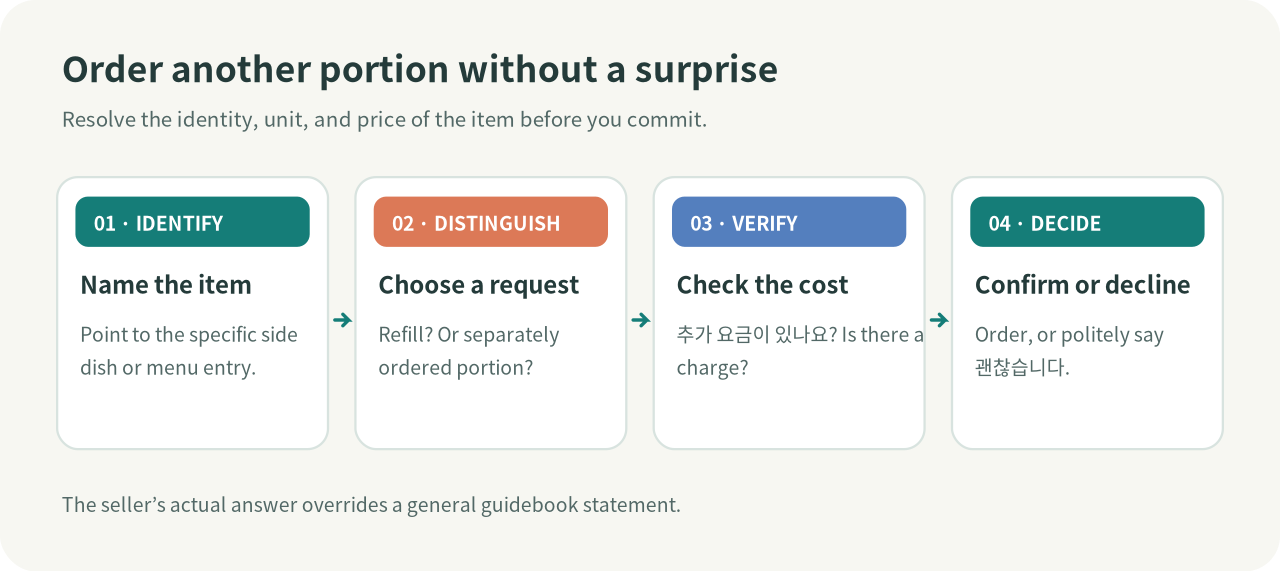
These sentences express different intentions. 더 주세요 means “Please give me more,” but without a clear object or pointing gesture the staff may not know which food you mean. 추가할게요 signals an added order; if price is not obvious, ask 추가 요금이 있나요? before confirming it.
Scene 1: more kimchi with lunch
Original fictional dialogue; no venue-specific terms are asserted.
You: 저기요, 김치 좀 더 주실 수 있나요?
Excuse me, could we have a little more kimchi?
Staff: 네, 잠시만요.
Yes, just a moment.
You: 감사합니다.
Thank you.
Here 김치 identifies the exact dish. Because a staff member agreed to bring it, you can wait. But this exchange alone does not establish the price. If it matters to you, especially where a menu lists separate charges or limits, add 추가 요금이 있나요?. Do not infer from a smile that every future refill is free.
Scene 2: a self-service side-dish station
You: 반찬은 여기서 가져가면 되나요?
Should I get the side dishes from here?
Staff: 네, 필요한 만큼 가져가세요.
Yes, take what you need.
You: 알겠습니다. 감사합니다.
Understood. Thank you.
Even when the staff invite you to help yourself, take reasonable portions, avoid mixing utensils between containers, and do not take an item intended for paid takeout. A posted sign or staff explanation may limit the number of refills, the eligible menu, or whether food can be taken away. 필요한 만큼 means “as much as you need” in this example; it is not permission to pack a container to leave.
Scene 3: another bowl of rice
You: 공깃밥 하나 추가할게요.
I'd like another bowl of rice.
Staff: 네, 추가 요금이 있어요.
Okay, there's an extra charge.
You: 얼마예요?
How much is it?
Staff: (States the actual current price.)
You: 네, 주세요.
Okay, please bring it.
The staff's price must come from the real menu or the operator's answer, not a number invented for a language lesson. The act of asking a price before confirming the order is normal and polite. If you decide not to proceed, 그럼 괜찮습니다. 감사합니다 (“In that case, no thank you”) is a courteous ending.
Scene 4: the difference between a portion and a refill
You want another grilled-meat portion after finishing the first. The waiter may see this as a new paid order even if the original meal included refills of several banchan dishes.
You: 이거 한 접시 더 주문할 수 있나요?
Can I order another plate of this?
Staff: 네, 추가 주문 가능합니다.
Yes, you can order more.
You: 가격은 얼마예요?
What's the price?
A 접시 (jeopsi) is a plate; 한 접시 means one plate. Some foods are sold by serving, person, weight, or set rather than plate. Point to the menu item and verify the actual unit before ordering; 이 메뉴 하나 더 주문할게요 (“I'll order one more of this menu item”) is often safer than guessing the unit.
What the sign can tell you—and what it cannot
You may see 반찬 셀프 (“Self-service side dishes”) or 셀프바 이용 (“Use of self-service bar”). The word 이용 means “use.” It does not tell you whether the station is included for all customers or only those ordering certain menus. If a sign says 추가 메뉴는 별도 요금 (“Additional menu items incur a separate charge”), that is a clear reason to check the listed price.
An official Korea Tourism Organization food-translation reference contains both 물, 반찬, 밥은 셀프입니다 (“Water, side dishes and rice are self-served”) and 추가 메뉴는 별도의 요금이 부과됩니다 (“Additional menu items incur extra charges”). It also lists notices about limited or unlimited refills. Those are examples of possible signage, not all conditions of one real restaurant. [2]
Common wrong assumptions, corrected
“The first kimchi was included, so the second order of dumplings is free.” No. They are different menu items. Ask whether the dumplings are a 추가 주문 (additional order) and check price.
“There is a self-service bar, so I can refill the soup as well.” The sign may apply only to designated sides. Ask where the permitted items are.
“무한리필 means I can share my paid portion with anyone at another table.” Not necessarily. All-you-can-eat service frequently has conditions about who paid and which dishes are eligible. Read the operator's actual terms.
“One more” means everyone at my table wants the same amount.” Not unless you say how many. 한 개 더 (“one more item”) and 한 접시 더 (“one more plate”) are not equivalent. Show the dish or menu entry, and confirm quantity.
“Refills are always safe for an allergy.” A free side-dish refill is not an ingredient or allergen guarantee. Shared utensils and surfaces may create cross-contact. Readers managing serious allergies should use a separate allergy-specific process and decline if staff cannot confirm safety.
A 45-second ordering drill
A. You want more of the same small kimchi dish, but you're unsure if it is included. Say 김치 좀 더 주실 수 있나요? 추가 요금이 있나요? (Could I have some more kimchi? Is there an extra charge?)
B. You want a whole second bowl of rice. Don't say only 리필 주세요. Instead say 공깃밥 하나 추가할게요 and confirm the price if necessary.
C. A posted notice reads 반찬 셀프. What may you take? Only what that station and its instructions make available to customers. If unclear, 이 반찬 가져가도 돼요? (“May I take this side dish?”).
D. Staff say 추가 요금이 있어요 (“There's an extra charge”). What next? 얼마예요? (“How much is it?”). Accept or decline before the extra food is prepared.
Your pocket card
반찬 좀 더 주실 수 있나요? — Could I have more side dishes?
반찬 리필 돼요? — Can the side dishes be refilled?
추가 요금이 있나요? — Is there an extra charge?
공깃밥 하나 추가할게요. — I'll order another bowl of rice.
그럼 괜찮습니다. — In that case, no thanks.
The practical outcome is simple: you have named the exact item, distinguished refill from added order, and confirmed charges when they matter. A separate language lesson can help you ask how drinking water is served; this lesson helps you avoid paying for a second portion you thought was a complimentary side dish.
Sources and practical limits
[1] Korea Tourism Organization, About Korean Food – Visiting a Korean Restaurant, general discussion of complimentary water/side dishes and self-service restaurant practices. Official page, accessed 30 October 2026. The page itself warns that its information may change.
[2] Korea Tourism Organization, A Guide to Translating Korean Food, translated signage examples for self-service water/side dishes/rice, additional menu charges and specific refill conditions. Official terminology reference PDF, accessed 30 October 2026.
Editorial disclosure: This is original beginner-language training, not a transaction quote, official price list, restaurant directory or promise that one custom is universal. All dialogues are fictional. The two included SVG figures are original teaching diagrams, not photographs.