Free · South Korea
Less Sweet, Please: Asking What a Korean Cafe Can Actually Change
The words for a gentler drink are easy. Finding out whether the recipe can change is the useful skill.
A drink arrives at your table looking exactly like its menu photograph. You take a sip: sweeter than you expected. Next time, you want to ask before the barista starts preparing it. The natural Korean request is 덜 달게 해 주실 수 있나요? — Could you make it less sweet? But that sentence cannot remove sugar from an already mixed bottle, a sweetened powder, or a premade syrup. Ordering well means asking what can actually be adjusted, then listening carefully to the answer.
This is a practical beginner-language guide, not a claim that Korean cafés share a national sweetness scale. Individual shops use different recipes, syrups, powders, milk, concentrates, and preparation methods. A zero-sugar claim is a separate factual claim and should never be inferred from a request for a less sweet drink.
Six phrases worth learning
| Korean | Plain English | When to use it |
|---|---|---|
| 이 음료 달아요? | Is this drink sweet? | Before selecting a drink on an unfamiliar menu. |
| 덜 달게 해 주실 수 있나요? | Could you make it less sweet? | Before production, if the recipe can be altered. |
| 당도 조절할 수 있나요? | Can the sweetness level be adjusted? | At a counter with configurable drinks. |
| 시럽을 적게 넣어 주실 수 있나요? | Could you put in less syrup? | When a measured syrup can be reduced. |
| 시럽 빼 주실 수 있나요? | Could you leave out the syrup? | When an optional syrup can be omitted entirely. |
| 이미 달게 만들어져 있나요? | Is it already made sweet? | To learn whether the sweet component is premixed. |
덜 (deol) means less, and 달다 (dalda) means to be sweet. The National Institute of Korean Language's learner dictionary explicitly uses 주스가 덜 달다 (the juice is less sweet) as an example of 덜. [1] In the counter sentence, 덜 달게 means so that it tastes less sweet. The Romanization in this lesson is only a rough pronunciation prompt; Hangul and an audio resource are better than treating English spelling as exact sound.
A shorter request, 덜 달게 해 주세요 (Please make it less sweet), is also polite. The longer question 해 주실 수 있나요? is particularly helpful because you are asking if a modification is possible rather than assuming it is. You can add 가능하면 (if possible) to acknowledge that the drink may have a fixed recipe.
Three different situations that should not be confused
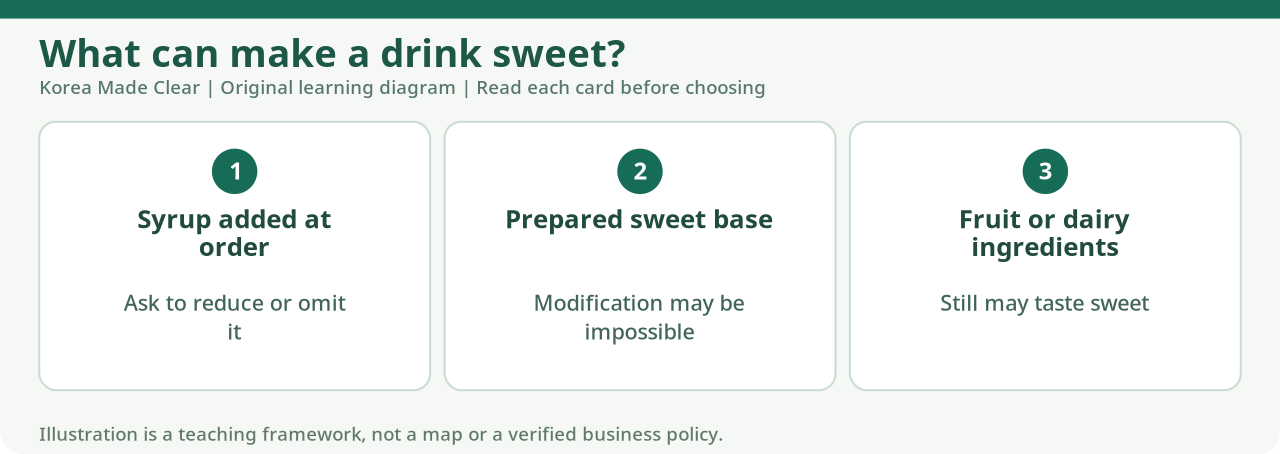
1. Sugar or syrup added during preparation. The café may be able to reduce or omit a measured syrup. Ask 시럽을 적게 넣어 주실 수 있나요? (Could you put in less syrup?) Then check whether other sweetened ingredients are still present. An amount reduced is not an ingredient eliminated.
2. A pre-sweetened base. A bottled tea concentrate, flavored powder, or premixed beverage may not have an adjustable sweetness. Ask 이건 이미 달게 만들어져 있나요? (Is this already made sweet?) A response of 네, 이미 만들어져 있어요 (Yes, it is already prepared) means your request may not be feasible. Consider another drink rather than asking staff to promise the impossible.
3. Sweetness from the underlying ingredients. Fruit and dairy products can taste sweet without a separate shot of café syrup. Removing syrup may leave natural sweetness or other sweetened ingredients. 설탕 안 넣으면 안 달아요? (If no sugar is added, is it not sweet?) is not a dependable assumption. Ask about the actual recipe and choose a simpler item when necessary.
Dialogue: a syrup that can be changed
Illustrative example, not a report from a real business.
Customer: 이 음료 달아요?
Is this drink sweet?
Barista: 네, 좀 달아요.
Yes, it's a little sweet.
Customer: 시럽을 적게 넣어 주실 수 있나요?
Could you use less syrup?
Barista: 네, 가능해요.
Yes, that's possible.
Customer: 감사합니다. 그렇게 해 주세요.
Thank you. Please do that.
The most important response is 가능해요 (possible)—but it might be 어려워요 (difficult/not possible) or 조절이 안 돼요 (it can't be adjusted). Repeating your original request does not change the recipe's constraints. Ask for another item if you receive a clear refusal.
Dialogue: the menu does not offer an adjustment
Customer: 당도 조절할 수 있나요?
Can you adjust the sweetness?
Barista: 이 메뉴는 안 돼요. 이미 만들어져 있어요.
Not for this item. It is already prepared.
Customer: 알겠습니다. 그러면 무가당 차가 있나요?
I understand. Then do you have unsweetened tea?
Barista: 네, 이 차는 무가당이에요.
Yes, this tea is unsweetened.
Customer: 그걸로 주세요.
I'll take that one, please.
The example deliberately distinguishes 무가당 (no added sugar / unsweetened, as the label is used) from 덜 달게 (less sweet). Actual product labels, dietary ingredients and sweeteners must be verified individually; neither phrase alone establishes that a drink is suitable for someone managing a medical condition.
What to do at a self-order kiosk
Some kiosks provide an explicit choice such as 당도 (sweetness) or 시럽 (syrup) with selectable levels. Others do not. A kiosk setting is not a universal feature of Korean cafés. If a required option is absent, do not assume a text note has been received by the barista. Ask at the counter 변경할 수 있나요? (Can it be changed?) before paying or finalizing the order. If you already paid, ask whether the order can still be altered; do not assume a refund is guaranteed.
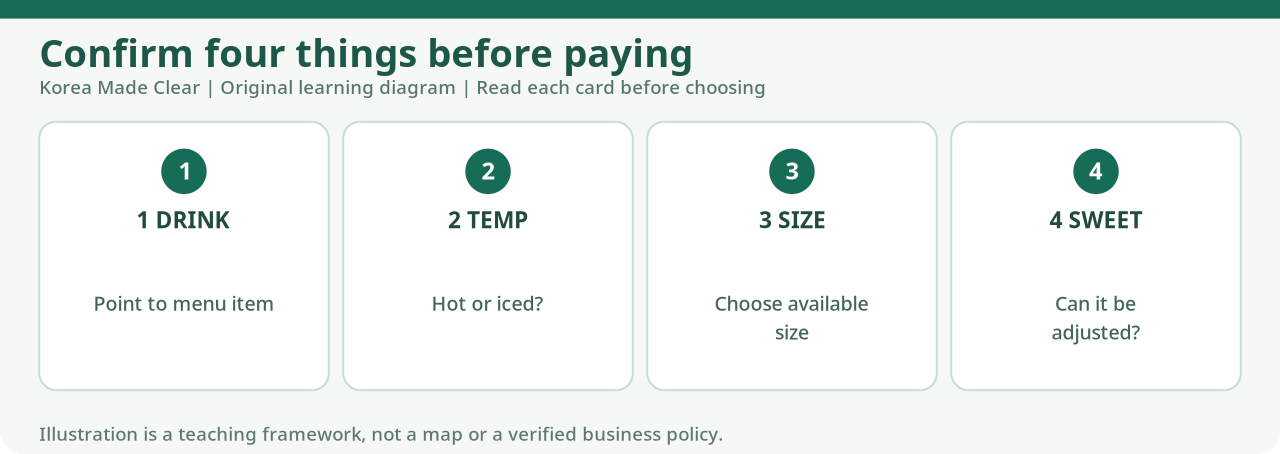
A clear order separates four things: which drink, hot or iced, size, and sweetness request. Mixing all of them into one long unpracticed sentence invites mistakes. Show the actual menu item and then make one short modification request.
The safety distinction: preference is not an allergy check
If you need to avoid a particular ingredient due to allergy, medication, diabetes-management advice or another medical reason, less sweet is not a reliable substitute for ingredient verification. A lower syrup setting does not prove the final drink is sugar-free; a staff member's reassurance about taste is not an ingredient or nutrition declaration. Ask for the written label or recipe information and explain the actual restriction. If the shop cannot confirm, do not rely on this phrase as a medical safety measure.
Likewise, not every café can change milk type, toppings, ice or temperature. These are independent choices that may affect cost and preparation. Treat a displayed menu price as specific to the exact options chosen; ask whether an add-on is charged separately.
A 45-second practice drill
A. The menu says a milk tea uses a prepared sweet concentrate. Should you assume 덜 달게 해 주세요 will make it sugar-free? No. Ask whether the base is premixed; choose a different drink if needed.
B. The staff says 시럽은 뺄 수 있어요 (The syrup can be left out). What do you confirm? Which syrup, and whether any other sweetened base remains.
C. You want a less-sweet drink but do not know whether changes are allowed. Try 덜 달게 해 주실 수 있나요?. Listen for 가능해요 / 안 돼요 / 어려워요.
D. You have a severe allergy and the cashier says the drink is not very sweet. Is that clearance? No. Sweetness and allergen safety are different questions; ask about exact ingredients and cross-contact.
Pocket script
이 음료 달아요? — Is this drink sweet?
덜 달게 해 주실 수 있나요? — Could you make it less sweet?
이미 만들어져 있나요? — Is it already prepared?
그럼 다른 걸로 할게요. — In that case I'll choose something else.
감사합니다. — Thank you.
Sources and limits
[1] National Institute of Korean Language, Korean-English Learners' Dictionary, 덜 (less), including the example “주스가 덜 달다”: https://krdict.korean.go.kr/eng/dicSearch/SearchView?ParaNationCode=6&ParaWordNo=48653&captchaNumber=&commentTitle=&comment_user_name=&divSearch=defViewGlobal&nation=eng&nationCode=6&viewTypes=on&wordComment=
[2] Korea Tourism Organization, Tasty and Fancy Daehakro Tour, describing real cafés and one milk tea's less-sweet flavor as a specific product example, not a general café policy: https://english.visitkorea.or.kr/svc/contents/contentsView.do?vcontsId=172033
[3] Online King Sejong Institute, official Korean-learning portal for pronunciation study: https://www.iksi.or.kr/lms/main/main.do?lang=EN
Scope: Original fictional teaching dialogues; checked 30 October 2026. No empirical survey of café policies or ingredient specifications, no pronunciation recording, and no assurance that any particular drink is adjustable. Independent Qwen review and GPT final adjudication pending; not published.