Free · South Korea
Is Tax Included? Asking for the Final Price in a Korean Shop
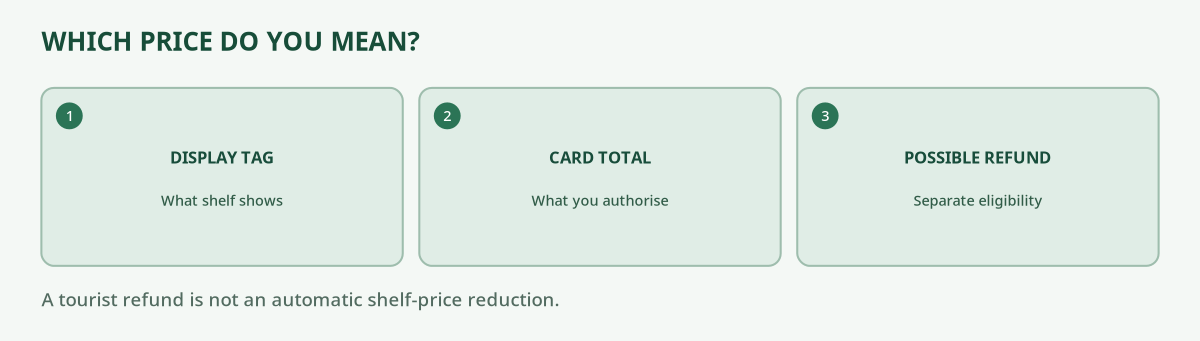
A price tag, a card-terminal total and a tourist tax refund are three different questions.
A coat on the rack is marked 79,000 won. At the register the clerk asks whether you want gift wrapping. You are not sure if the number on the tag includes tax or whether you will see a higher number on the card terminal. You have heard that tourists sometimes get a tax refund in Korea. Does that mean you should pay less today?
Those uncertainties are related but separate. A label is the shop's displayed price. The total you authorise is the current transaction amount. A refund under a certified visitor programme, where applicable, happens according to another set of eligibility and paperwork rules. Confusing them can turn an ordinary shopping decision into an avoidable dispute.
Begin with two simple Korean questions:
이 가격에 세금이 포함돼 있나요? — Does this price include tax?
표시된 가격이 최종 금액인가요? — Is the displayed price the final amount?
The first asks about a tax component; the second asks what you actually have to pay after any eligible discount, accessory, delivery, gift wrapping or additional service charge. Most travellers need the second answer before authorising a transaction.
Three prices that should not be mixed
Displayed price (표시 가격): the number shown on a tag, shelf, menu or website. Its treatment depends on the context and applicable price-display rules. Do not add a guessed 10 percent to every Korean shelf label merely because Korea has a VAT system.
Checkout amount (결제 금액): the exact amount on the terminal before you tap or approve. It might differ from an original price because a discount was applied, because a separately described service was added, or because you selected a different item. Ask the merchant to explain a difference rather than assuming which component caused it.
Tax refund (세금 환급): a possible process for eligible purchases by eligible visitors at qualifying businesses, not a universal discount on every item or a promise that 10 percent of the displayed price will be returned. The Korea Tourism Organization explicitly distinguishes duty-free stores, regular tax refunds and immediate tax refunds. [2][3]
The Korean phrases you can actually use
| Korean | Approximate reading | Functional English |
|---|---|---|
| 이 가격에 세금이 포함돼 있나요? | i gagyeoge segeumi pohamdwae innayo? | Is tax included in this price? |
| 부가세 포함인가요? | bugase pohamingayo? | Does it include VAT? |
| 표시된 가격이 최종 금액인가요? | pyosidoen gagyeogi choejong geumaeng-ingayo? | Is the displayed price the final amount? |
| 추가 비용이 있나요? | chuga biyongi innayo? | Is there an additional charge? |
| 총 얼마예요? | chong eolmayeyo? | What is the total? |
| 영수증 받을 수 있을까요? | yeongsujeung badeul su isseulkkayo? | Could I have a receipt? |
The romanizations are approximate reading aids, not exact sound transcriptions. 부가세 means value-added tax, commonly abbreviated VAT in English. 포함 means inclusion; 추가 means extra/additional; 최종 금액 means the final amount. Check the official National Institute of Korean Language learner dictionary for the component words. [1]
You can show the phrase on your phone. Say or show one question at a time, preferably while pointing to the price label and the actual total. That allows the cashier to compare the same item instead of explaining an entire tax system in English.
A jacket at a regular shop: one question solves it
Fictional practice dialogue; the numbers are hypothetical and not a price survey.
Customer: 이 가격에 세금이 포함돼 있나요?
Is tax included in this price?
Clerk: 네, 포함돼 있어요.
Yes, it's included.
Customer: 표시된 가격이 최종 금액인가요?
Is the displayed price the final amount?
Clerk: 네, 추가 비용은 없어요.
Yes, there's no extra charge.
Customer: 감사합니다. 영수증 주세요.
Thank you. A receipt, please.
If the clerk gives a different answer, verify the total before paying. You do not need to calculate an assumed VAT component yourself to ask whether the displayed price is final.
A separate charge at the register
Suppose a gift comes with an optional 2,000-won wrapping service. The tag said 28,000 won; the total now shows 30,000 won. In this invented case the difference is wrapping, not necessarily tax. Ask 추가 비용이 있나요? and then 그 비용은 무엇인가요? (What is that charge for?) before accepting the extra service. If you do not want it, ask 포장은 빼 주세요 (Please leave out the wrapping) and have the total recalculated. The merchant may decline to change an already completed customised order, so ask before agreeing.
A price mismatch can also result from an item scanned twice. Check the product name and quantity; do not tell the clerk the tax is wrong before knowing what was entered.
What the tourist "Tax Refund" sign actually means
A participating shop may have a certified Tax Refund or Tax Free sign, but the terms do not make every traveller or every purchase eligible. The official VISITKOREA materials distinguish:
- Duty-free purchase: some taxes are not charged on qualifying sales at a dedicated duty-free store.
- Regular tax refund: a qualifying purchase may initially be paid at a tax-inclusive price; the visitor later follows the relevant refund process with required evidence.
- Immediate tax refund: some participating outlets apply an eligible refund at checkout; the amount depends on purchase and visitor requirements.
Importantly, eligible tourist refunds are not the same as a general store discount and cannot be claimed from every purchase using only an ordinary bank statement. The official information, last updated in 2025, sets residence, purchase and documentation conditions that may change. Do not rely on a numerical threshold in a travel article instead of consulting the current store programme. Some goods that have been used or opened may not qualify. [2][3]
Useful follow-up: 택스 리펀드가 가능한가요? (Is tax refund available?) This English loan phrase may be understood at participating tourist-oriented stores, but staff may use different terminology. Read the certified signage and ask what documentation is needed. Do not assume a local café meal, transport fare or service will qualify under a shopping-goods scheme.
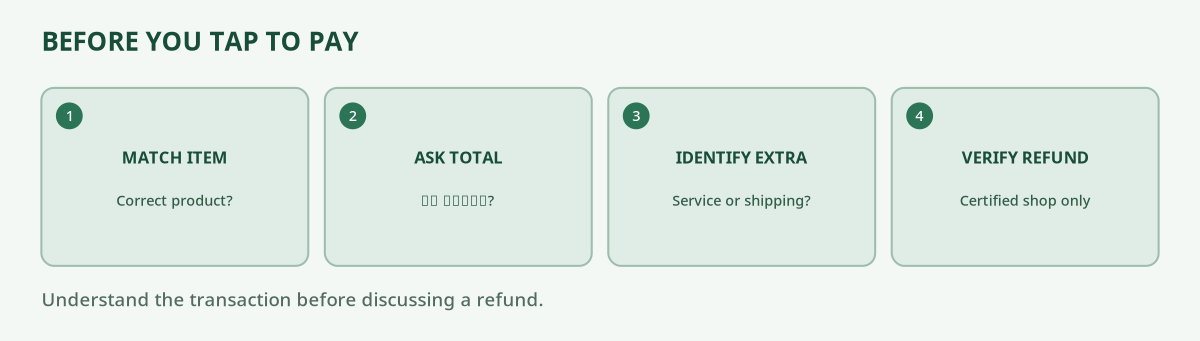
An example with three different totals
The price label reads 50,000 won. At checkout an eligible participating scheme might show an adjusted amount, or a separate 3,000-won service may be proposed. These are separate hypothetical paths, not steps that necessarily happen together.
Ask first: 표시된 가격이 최종 금액인가요? If the answer is yes, confirm 50,000 won. If not, ask 그 비용은 무엇인가요? Next decide whether you want an optional add-on. Only then ask about a possible certified tax refund and whether the merchant can supply the required documents. That sequence keeps a confusing price discussion grounded in the actual transaction rather than in remembered tourism advice.
If someone in line says "All Korean prices have ten percent added at checkout," do not treat that as a reliable rule for the price in front of you. Equally, do not assume every store has a tourist tax refund programme. The reliable evidence is the actual item, displayed total, merchant terms and current official programme.
A pocket script before paying
실례지만 표시된 가격이 최종 금액인가요? 추가 비용이 있나요?
Excuse me, is the displayed price the final total? Is there an additional charge?
Once you understand the answer, check the number shown on the register and keep appropriate proof of payment. You have achieved the main objective without needing to give tax advice or pronounce a long compound sentence perfectly.
Primary sources and scope boundaries
[1] National Institute of Korean Language, Korean-English Learners' Dictionary — search 가격, 포함, 금액, 부가세, 추가 and other words used here; lexical support, not statutory interpretation.
[2] Korea Tourism Organization, Duty Free & Tax Refunds — comparison of duty-free shopping, regular tax refunds and immediate tax refunds; last updated by the provider in October 2025.
[3] Korea Tourism Organization, Comprehensive Tax Refund Guide — eligibility and eligible/noneligible items, last consulted October 2026. Regulations and thresholds change; consult the current programme when actually buying.
This English-language lesson does not advise on the tax treatment of an individual transaction or guarantee a legal right to a refund. Example totals are invented to teach the questions, and no live merchant pricing or policies were checked.