Free · South Korea
Another Size, Please: How to Read Clothing Labels and Ask in Korean
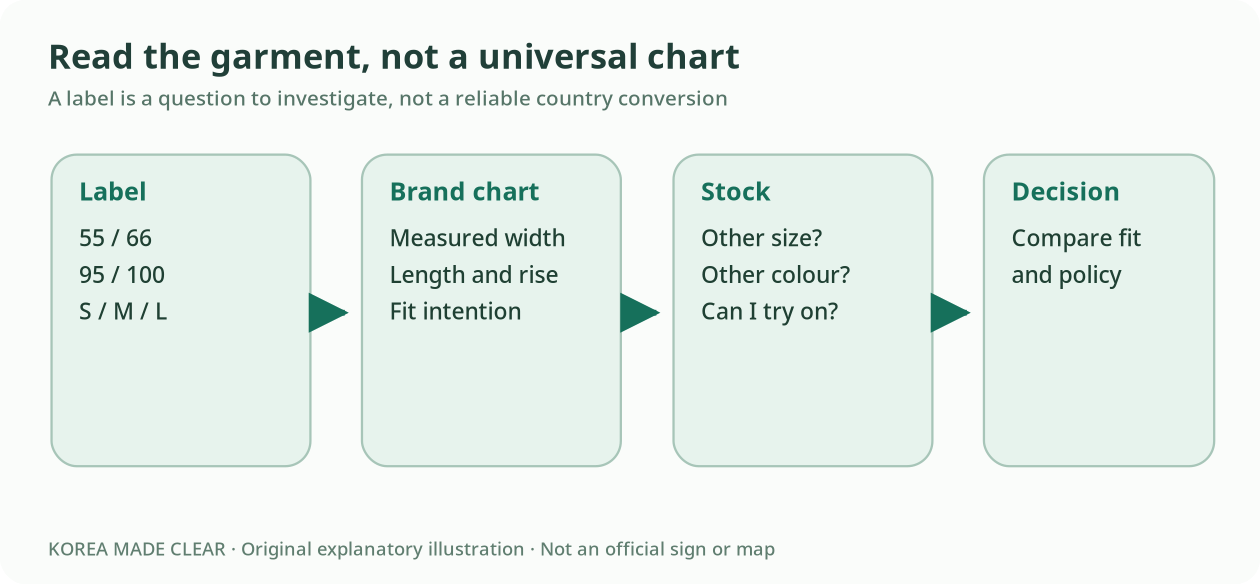
The number on a label is a starting point for a question, not a guarantee of fit.
You find a jacket you like in a shop in Seoul. The collar label reads 100. A nearby shirt reads L. In another store, two trousers with the same waist number have entirely different cuts. You want to ask for a different size, but you do not know whether the number represents a body measurement, a brand convention or a style label.
Rather than memorising a supposed conversion between every Korean and overseas size, learn a better sequence: show the actual item, identify the exact size printed on its label, ask about an alternative and check fit before paying. That approach works with department stores, independent boutiques and clothing markets without pretending they operate one national sizing chart.
The line you can use immediately
다른 사이즈도 있어요?
Do you have another size?
If you want a particular size, show the tag and ask:
이거 95 사이즈 있어요?
Do you have this in size 95?
Use 이거 (this one) while holding or pointing to the item. 다른 means another/different; 사이즈 is the common loanword for size. Your approximate pronunciation cue is dareun saijeudo isseoyo? A learner can simply show the Hangul on a phone if spoken Korean is difficult.
Six practical phrases
| Korean | Functional English | Useful moment |
|---|---|---|
| 이거 다른 사이즈도 있어요? | Do you have this in another size? | Pointing to the same item |
| 조금 더 큰 사이즈 있어요? | Do you have one a little bigger? | Fit is too tight |
| 조금 더 작은 사이즈 있어요? | Do you have one a little smaller? | Fit is too loose |
| 이 사이즈 재고 있어요? | Is this size in stock? | Checking inventory |
| 사이즈 표를 볼 수 있을까요? | Could I see the size chart? | Brand-specific comparison |
| 입어 봐도 될까요? | May I try this on? | Asking about a fitting room |
재고 means stock/inventory. 입어 보다 means to try wearing something, rather than assuming you may use a changing room without permission. The final phrase is a preview of a separate fitting-room lesson; here the focus remains finding the right size and understanding the label.
Why 55, 66, 95 and M are not a universal translator
You will encounter tags such as 44, 55, 66 or 77 in some Korean women's clothing lines, 90, 95, 100 or 105 in some men's tops, and international letter sizes such as S, M, L or XL. These are recognizable examples of commercial label conventions. They are not an official conversion table that maps reliably to a US, European or UK size. Brands, cuts, fabric stretch and intended fit change the meaning. Some retailers use centimetre measurements; others use inches for a waist label or their own internal size codes.
For instance, a shirt marked 100 might fit one shopper, while another brand's 100 is tight through the shoulders. Nothing in the number alone tells you sleeve length, fabric stretch, ease or whether the product is intentionally oversized. A pair of trousers labelled 28 may still differ in waist placement, leg opening and rise.
Better question: 실측 사이즈가 어떻게 돼요?
What are the actual garment measurements?
For a detailed item, ask 가슴 단면이 몇 센티미터예요? (How many centimetres is the flat chest width?) or show a measurement diagram if your Korean is limited. Remember that flat width and body circumference are different measurements. Do not multiply numbers unless the label explicitly defines what was measured. If only a general chart is available, compare your own garment's measurements, not only your usual international letter size.
A fitting-room exchange
An illustrative shop conversation, not a guarantee of a named merchant's stock.
Customer: 저기요, 이거 다른 사이즈도 있어요?
Excuse me, do you have this in another size?
Staff: 어떤 사이즈 찾으세요?
Which size are you looking for?
Customer: 조금 더 큰 사이즈요.
A slightly larger one, please.
Staff: 100 사이즈는 품절이에요.
Size 100 is sold out.
Customer: 그러면 사이즈 표를 볼 수 있을까요?
Then could I see the size chart?
품절 means sold out. It is not necessarily a statement that the item was never made in that size. If the staff cannot find the item, you may ask 다른 색상은 있어요? (Do you have another colour?) but do not assume another colour has identical stock or fit.
Notice that the customer does not announce a US or EU size as if it must be recognised. They ask about the item in front of them, giving the employee enough information to search the shop's inventory.
When the tag isn't enough
Four useful checks for readers who shop without fluent Korean:
- Garment type: Jackets, knitwear, fitted shirts and sportswear may use different size conventions even within one brand.
- Fabric and cut: A stretch waist and a structured waist are not interchangeable. The words 오버핏 (oversized fit) or 슬림핏 (slim fit) describe styling, not a guaranteed measurement.
- Display versus stock: A model on the rack can be a display item. Ask before assuming the exact colour and size is available for sale.
- Return and exchange conditions: Check the store's actual policy before paying. A size mismatch is not proof that all shops must accept a return after use, removing tags or washing.
If the shop has no fitting room, ask 여기서 입어 볼 수 있어요? (Can I try it on here?). If the answer is no, compare measurements and check the exchange conditions. Do not treat the floor or a hallway as a private changing space.
An online listing is a different problem
Online merchants may have detailed charts, but they can also use a model's height and worn size to suggest fit. That is a description of a photographed model, not a conversion standard. Check units, garment measurements, and shipping/return conditions in the actual product listing. For cross-border orders, customs, shipping fees and return addresses can change the practical cost of exchanging a poor fit. Nothing in the basic phrase 다른 사이즈도 있어요? guarantees free delivery or an exchange.
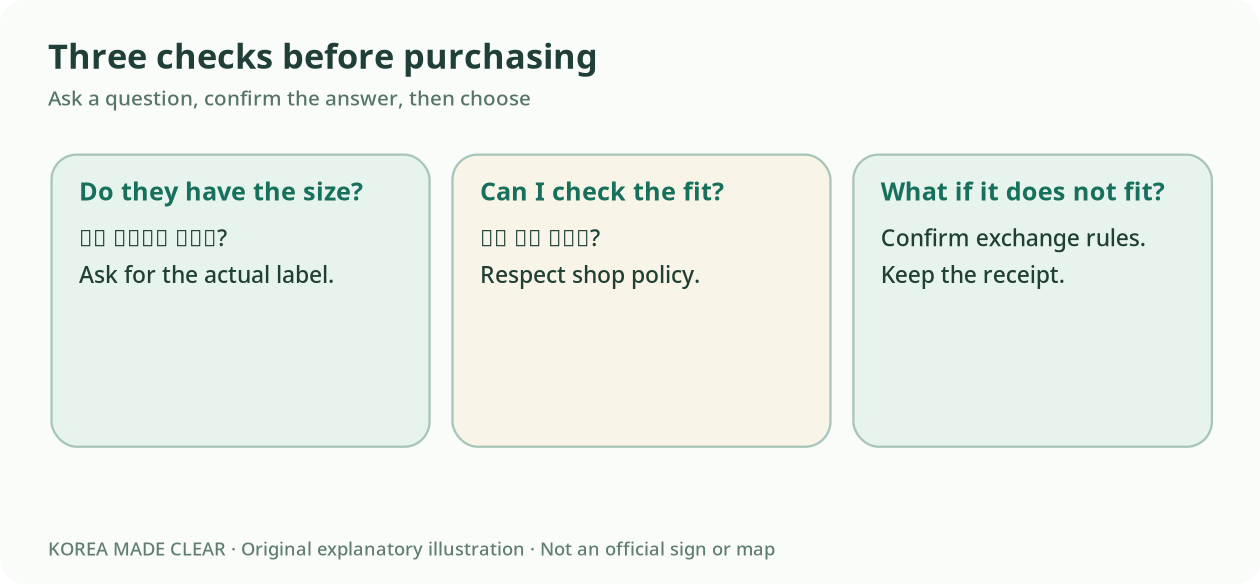
Practice: two shoppers, two problems
Problem A: A jacket is comfortable through the body but the sleeves are short. Do not automatically request one size larger without considering shoulder fit. Ask to try a second size and compare sleeves and shoulders.
Problem B: A label reads M but the garment is extremely oversized. Ask for the product's 사이즈 표 (size chart), look for actual measurements, and request another size if necessary. You are choosing a fit, not proving which country's letter chart is correct.
Pocket script:
이거 다른 사이즈도 있어요? ... 조금 더 큰 사이즈요. ... 사이즈 표를 볼 수 있을까요? ... 입어 봐도 될까요?
Another size? A little bigger. Could I see the size chart? May I try it on?
The habit to remember: show the specific garment, ask about the size printed on its label, and verify how that brand measures it. A polite question and a real chart are more reliable than a one-line international conversion promise.
Sources and editorial limits
[1] National Institute of Korean Language, Korean-English Learners' Dictionary — Korean vocabulary for size (크기), inventory (재고), sold out (품절) and dressing (입다). These are lexical sources, not retail policy.
[2] King Sejong Institute Foundation — Online King Sejong Institute — supplementary Korean language-learning resource. No named store inventory or sizing chart is attributed to this portal.
No named shop's 2026 stock, fitting-room permissions, exact size chart, prices or refund terms were verified. The label numbers in this article are examples of widely encountered practices, not a certified national or cross-brand size conversion. All dialogues are illustrative.