Free · South Korea
Card or Cash? Ask Before You Pay in a Korean Shop
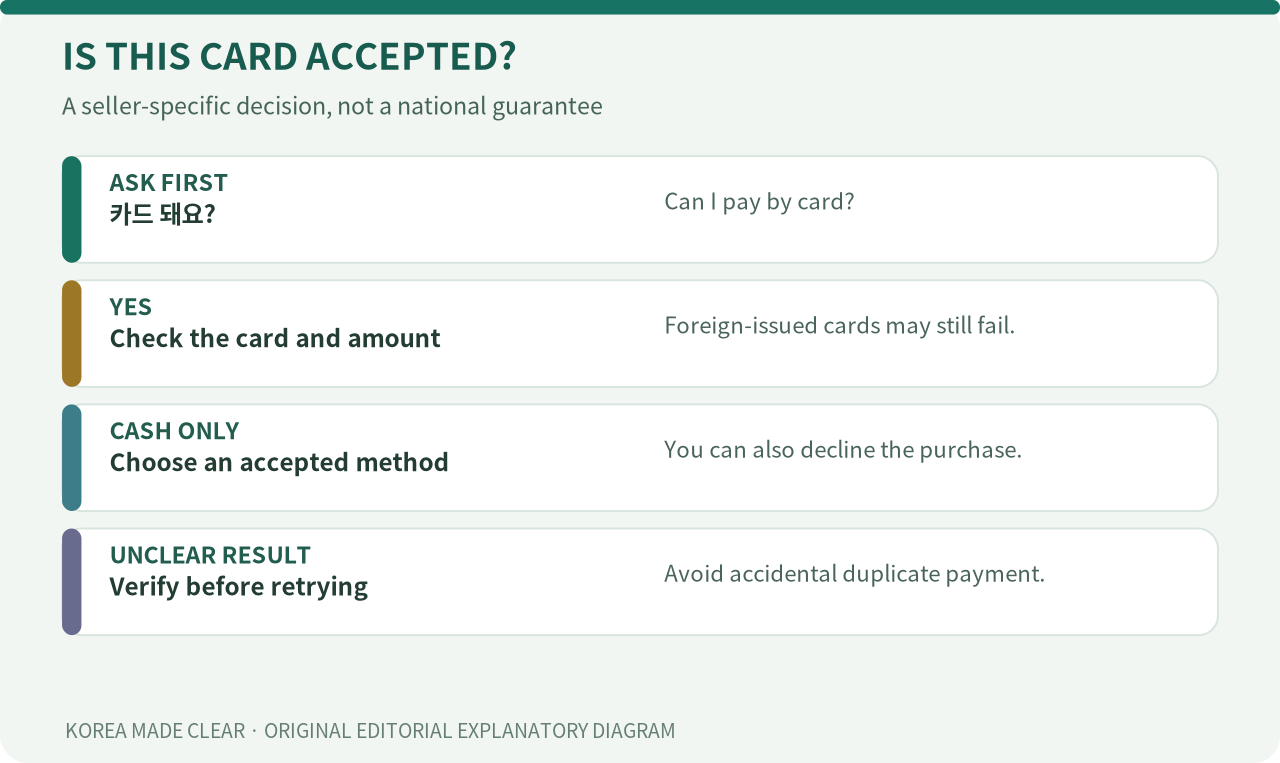
Most familiar shops will take cards. One small question prevents you from discovering the exception after your purchase has been wrapped.
A shopper picks out a small souvenir at a street stall. The seller reaches for a bag. The shopper holds up a card, pauses, and asks 카드 돼요? (Can I pay by card?). It isn't an apology for being a foreign visitor. It's a practical question about this sale, at this counter, with this card.
Korea is a highly card-friendly shopping destination. The Korea Tourism Organization says credit cards are widely accepted, but also warns that some small merchants, street sellers and traditional-market shops may take only cash. Those two statements are not contradictory: the general convenience of a payment system does not guarantee that a particular merchant, network or foreign-issued card will work. [1][2]
This lesson is about confirming payment before you create an awkward checkout problem—not about pretending to know a shop's policy in advance.
Ask whether the shop accepts a card
카드 돼요?
Kadeu dwaeyo?
Can I pay by card?
The shorter question is common in shops and cafés. 카드 is the borrowed word card, and 돼요? asks whether something is possible/allowed. Pointing to your card makes the reference clear. If you want a slightly fuller service-counter phrase, say:
카드로 결제할 수 있나요?
Kadeuro gyeoljehal su innayo?
Can I pay by card?
Both are usable. The longer sentence uses -로 (by/using) and 결제하다 (to make a payment). Neither question guarantees that a foreign-issued debit card, a prepaid travel card, contactless tap, mobile wallet or every brand on a sticker will work.
If you already know a card is accepted and simply want to state your choice, say 카드로 할게요. (I'll pay by card.). If the counter has both self-checkout and staff payment, establish where to pay before starting another transaction.
Six short phrases and replies that make a difference
| Korean at checkout | Meaning in context | Appropriate response |
|---|---|---|
| 네, 카드 돼요. | Yes, cards are accepted. | Confirm your card if unsure. |
| 현금만 돼요. | Cash only. | Choose a lawful available method or don't buy. |
| 이 카드는 안 돼요. | This card doesn't work/isn't accepted. | Ask once about another method; don't retry repeatedly. |
| 해외 카드도 돼요? | Do foreign-issued cards work too? | Ask before relying on an international card. |
| 여기서 결제해 주세요. | Please pay here. | Move to the indicated terminal/counter. |
| 영수증 드릴까요? | Would you like a receipt? | Say 네, 주세요 if you need one. |
현금 means cash; 해외 means overseas/foreign; 영수증 means receipt. A store's response can be about the type of card rather than whether it accepts any cards at all. If your card fails, ask 다른 카드로 해 볼까요? (Shall I try a different card?) only if you actually have one and the staff is happy to retry.
The expression 안 돼요 is a general no/it doesn't work. It does not tell you by itself whether the problem is the terminal, a network outage, a card restriction, or the bank's decision. Avoid announcing the reason when you cannot know it.
The extra question for an overseas card
A visitor's card may carry a globally familiar network logo, but a merchant can still have a different arrangement, or the particular terminal may reject the transaction. 해외 카드도 돼요? (Are overseas cards accepted too?) asks the right follow-up.
When the price is on the screen, check the amount and currency before confirming. If a terminal offers a choice between the local currency (Korean won) and conversion to another currency, you may want to consider your own card provider's foreign-exchange terms; don't assume the terminal's conversion is the cheapest. The basic Korean sentence 원화로 결제할게요. means I'll pay in Korean won. Whether you are actually offered a currency choice depends on your card and merchant; it is not guaranteed.
If you can't understand a prompt, don't repeatedly tap or enter a PIN because the person behind you looks impatient. You may show the screen and ask 이 금액이 맞나요? (Is this amount correct?) or 결제됐나요? (Did the payment go through?). A polite question can prevent a duplicate charge.
Security boundary: Do not say your PIN aloud, let a stranger photograph the front and back of your card, or send payment credentials by chat. You can ask staff for help understanding the device without revealing confidential information. For a suspected charge, check your bank's app or receipt; the seller's impression alone isn't proof of a final posting.
Three payment encounters
Illustrative dialogues; they do not describe actual merchants.
Scene A — A small market stall
Customer: 저기요, 카드 돼요?
Excuse me, can I pay by card?
Seller: 죄송해요. 현금만 돼요.
Sorry, cash only.
Customer: 알겠습니다. 그럼 다음에 올게요.
I understand. Then I'll come back another time.
There's no need to turn a brief cash-only reply into a debate. You can decide not to purchase, or use an accepted payment method if you have it. Never assume every traditional-market stall takes the same method as the large department store down the road.
Scene B — A shop with card payment
Customer: 카드로 결제할 수 있나요?
Can I pay by card?
Staff: 네, 여기서 결제해 주세요.
Yes, please pay here.
Customer: 해외 카드도 돼요?
Do overseas cards work too?
Staff: 이 카드로 한번 해 보세요.
Please try with this card.
Customer: 네. 금액부터 확인할게요.
Okay. I'll check the amount first.
Scene C — A possible duplicate
The first terminal attempt shows an unclear message. Do not tap again immediately. Ask 결제됐나요? (Did the payment go through?) and compare the displayed receipt and your card notifications. An authorization notification alone may not be a final settlement, but it is a reason to check carefully. When uncertain, ask the staff to verify the transaction status before attempting a new one.
Card, transport card and phone wallet are not synonyms
One word, 카드, can refer to many physical products. A public-transport card is designed for a particular fare or stored-value network; it is not automatically a credit or debit card. Some stored-value and travel products support shop payments at participating merchants, but their acceptance rules vary. In a lesson about buying souvenirs, don't assume a transit top-up card will behave like a Visa or Mastercard at every terminal. [3]
Likewise, 휴대폰으로 결제할 수 있어요? (Can I pay by phone?) is a valid question, not evidence that your own foreign mobile-wallet setup works in that location. A shop may accept certain domestic QR or NFC payment methods while rejecting a foreign mobile wallet. Point to the logo actually displayed and ask about that method specifically.
Card acceptance and card eligibility for a tax refund are different subjects. A tourist tax refund depends on the purchase, retailer and programme rules. The presence of a card terminal is not proof of an immediate tax refund, and a refund sign is not a promise about your individual transaction.
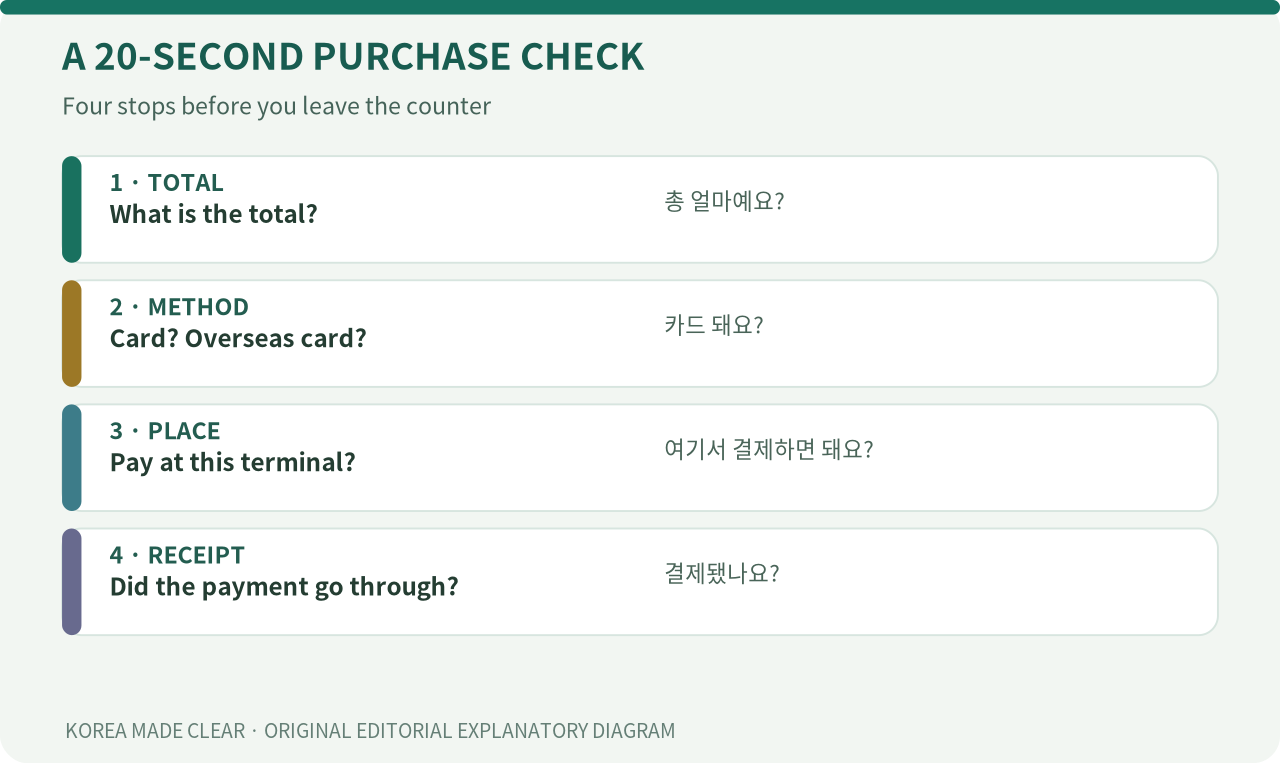
A 20-second purchase check
Before you hand over your payment method:
- Identify the item and total: Ask 총 얼마예요? (How much is the total?) if it isn't on the screen. A sign may show a per-item figure rather than the total for several products.
- Ask about the method: 카드 돼요? Then 해외 카드도 돼요? if necessary.
- Confirm the place to pay: Kiosk, counter or mobile terminal? 여기서 결제하면 돼요? (Should I pay here?)
- Check the outcome: If the first attempt is ambiguous, 결제됐나요?; verify before retrying.
Practice without learning a false nationwide rule
A: You see a Cards Accepted sticker at a café. Does it mean your particular overseas card is guaranteed to work? No. Ask 해외 카드도 돼요?, and try only after checking the displayed amount.
B: A street vendor says 현금만 돼요. Do you have to pay cash anyway? No. You can choose an accepted method or decline the purchase before taking the item.
C: Your bank app shows a pending notification, but the terminal appeared to time out. Should you immediately tap again? No. Ask staff to check, compare receipts, and verify transaction status first.
Pocket script: 카드 돼요? → 해외 카드도 돼요? → 여기서 결제하면 돼요? → 결제됐나요?
Cards accepted? → Overseas cards too? → Pay here? → Has it gone through?
Verified sources and what they don't establish
[1] Korea Tourism Organization — Korean Currency & Exchange Info. Official consumer guidance says major credit cards are widely used and advises checking before a purchase because some stores may not support the method.
[2] Korea Tourism Organization — Shopping in Korea. Official shopping guide notes some traditional-market and street businesses may accept only cash. It does not say every merchant has the same rules.
[3] Korea Tourism Organization — Transportation Cards. Distinguishes products with different payment/transport networks and limitations. This is general travel information, not proof that a specific merchant accepts a particular stored-value card.
[4] Korea Tourism Organization — Traditional Market Service Campaign, 28 May 2026. Describes the 2026 Smile Campaign with eleven named traditional markets across ten regions, including Mangwon and Gyeongdong in Seoul, Haeundae in Busan, Seomun in Daegu, Sinpo in Incheon and selected markets in Gyeonggi, Gangwon, Chungbuk, Jeonbuk, Gyeongbuk and Jeju. It identifies a limited participating group, not a card-acceptance guarantee for every stall even within those markets.
This is an original language-learning article. Rates, store acceptance, currency-conversion charges, payment-network support and refund policies can change; verify the actual merchant and your bank before making a purchase.