Free · South Korea
The Bill, Please: Where and When to Pay in a Korean Restaurant
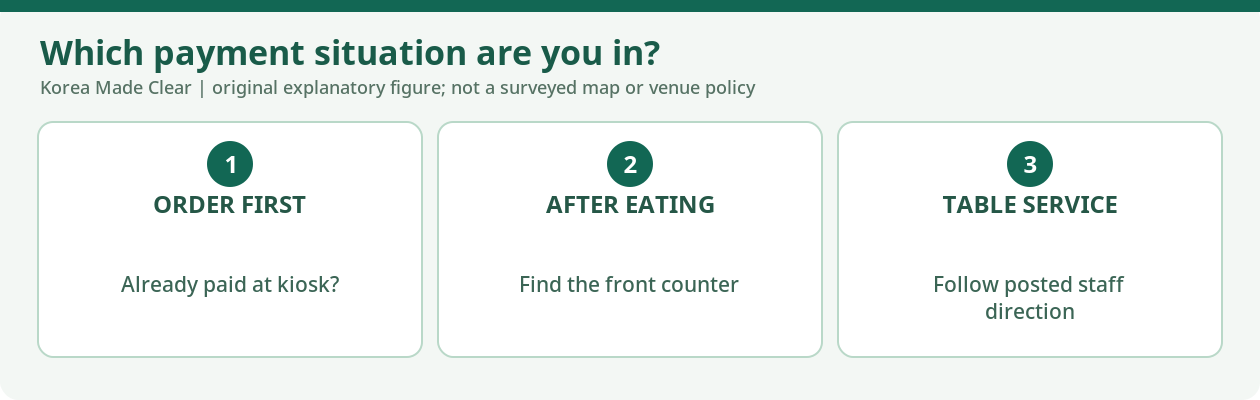
The useful question is often not "How much?" but "Where do I pay?"
The meal is finished, the bowls are being cleared, and nothing resembling a check has arrived. Across the room, another customer stands up and walks toward a small terminal by the entrance. A first-time visitor might worry that the staff have forgotten them. In fact, the restaurant may expect payment at the counter. Another establishment may have taken payment when the food was ordered. A third may use a table-side tablet. Knowing one likely pattern is helpful; pretending it is a rule for every business is not.
Here is the decision that matters: find out whether your order has already been paid, where payment is processed, and what amount is actually due. You do not need a perfect sentence to do it. You need a short question, a pause for the answer, and a glance at the displayed total before approving the payment. [1][2]
Five Korean lines worth keeping
| Korean | Pronunciation aid (approximate) | Everyday meaning |
|---|---|---|
| 어디에서 계산해요? | eodieseo gyesanhaeyo? | Where do I pay? |
| 계산할게요. | gyesanhalgeyo. | I'd like to pay now. |
| 계산해 주세요. | gyesanhae juseyo. | Please ring me up. |
| 영수증 주세요. | yeongsujeung juseyo. | A receipt, please. |
| 이미 계산했나요? | imi gyesanhaennayo? | Has this already been paid for? |
These are functional English translations, not a word-by-word dictionary analysis. 계산 is used for calculation and settling the amount, while 영수증 is a receipt recording a completed payment. The National Institute of Korean Language's learner dictionary records 계산하다 with the sense of calculating or settling money; the restaurant use is a practical application of that vocabulary. [3]
Calculating a bill is not the same as paying it twice. Before you use one of these phrases, see whether the kiosk receipt, app or cashier has already recorded a payment. If you paid before eating, you may only need to leave or collect a separate receipt. If you are unsure, show the paid receipt and ask 이미 계산했나요? (Has this already been paid?).
Scene 1: no check arrives at the table
An illustrative dialogue, not an observation of a particular restaurant.
Visitor: 저기요, 어디에서 계산해요?
Excuse me, where do I pay?
Staff: 앞쪽 계산대에서 하시면 돼요.
You can pay at the counter in front.
Visitor: 네, 감사합니다.
OK, thank you.
The important words are 앞쪽 (toward the front) and 계산대 (cashier's counter). If there is a paper slip on the table, bring it only if staff ask or if the posted instruction says to. If there is a table number on a tablet, keep that number available. A restaurant may use an order record instead of a physical check.
Do not leave a credit card sitting unattended on a table merely because you are accustomed to table payment elsewhere. Follow the actual employee's instruction and the accepted card-payment flow. The Korea Tourism Organization's general visitor guidance describes broad card acceptance; it also cautions that individual establishments can differ. [2]
Scene 2: you paid when ordering
Visitor: 이거 이미 계산했나요?
Was this already paid for?
Staff: 네, 주문할 때 결제하셨어요.
Yes, you paid when ordering.
Visitor: 알겠습니다. 영수증 받을 수 있을까요?
Understood. Could I get a receipt?
This conversation uses 결제하다 (to make a payment) as well as 계산하다 (to settle or calculate the bill). In ordinary café speech they may overlap. The most reliable proof of an actual charge is the payment receipt or confirmation, not an English sentence alone. Your card statement may not appear instantly; check the shop's terminal or receipt if the result is uncertain.
Scene 3: a displayed amount surprises you
Visitor: 금액을 다시 확인해 주시겠어요?
Could you check the amount again?
Staff: 어떤 부분이 궁금하세요?
Which part would you like to check?
Visitor: 추가 주문한 게 포함돼 있나요?
Is the extra item I ordered included?
The word 추가 means additional. It helps you ask whether a refill, extra serving, drink or packaging charge has changed the total. Do not accuse the cashier of fraud because a bill differs from your initial mental estimate. Point to the actual line item and ask about it calmly.
What if you need to correct an item before paying? Say 이 메뉴는 주문하지 않았어요 (I didn't order this item), and show the screen or printed line. Your goal is to identify the mismatch, not to demand a refund under a rule you have not checked. The business may need to inspect its order history.
Card, cash or another payment method
The everyday question 카드 돼요? means Do you accept cards? A more explicit version is 카드로 계산할 수 있어요? (Can I pay by card?). For cash, 현금으로 낼게요 means I'll pay in cash. A cashier may say 카드 넣어 주세요 (Please insert the card) or 카드를 단말기에 대 주세요 (Please hold the card to the terminal). Follow the terminal's current instructions and avoid handing a card or device to an unrelated person offering assistance.
Some overseas bank cards may fail at individual merchants despite otherwise widespread card acceptance. If a card fails, ask whether another valid payment method is accepted; do not assume any particular wallet, payment network or foreign currency will work. Prices should be checked in KRW, the Korean won, not a rough conversion remembered from last week. [2]
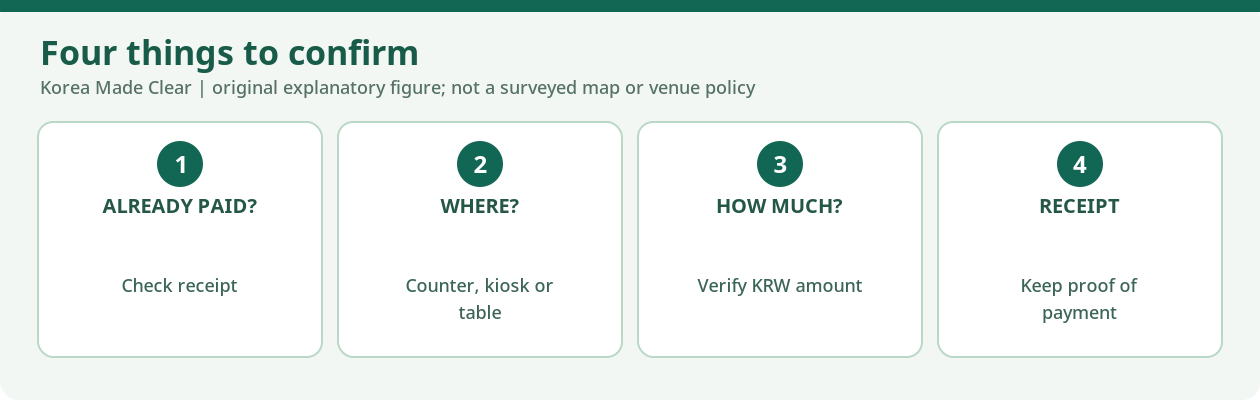
Two common misunderstandings
Misunderstanding 1: "The check never came, so nobody is expecting payment." Not necessarily. Pay-at-counter service is a common pattern. Ask where payment takes place instead of waiting indefinitely or walking away.
Misunderstanding 2: "If the waitress says 계산할게요, the restaurant has already charged me." No. Depending on the speaker and context, the phrase may announce an intention to pay or process the bill. Look for the completed terminal confirmation, not a spoken declaration alone.
A self-order kiosk is its own case: if an order screen asks you to confirm a card payment before food preparation, do not pay again at the counter unless the business can explain why a separate charge is due. Keep your receipt until you have collected your order.
Practice in twenty seconds
- You're finished eating. Nobody has brought a bill. Ask 어디에서 계산해요?
- The cashier shows a total with an extra item. Ask 금액을 다시 확인해 주시겠어요?
- You've just finished paying and want documentation. Ask 영수증 주세요.
- The card reader reports a failure. First verify whether the charge succeeded before retrying. Do not repeat payment mechanically.
Pocket script: 저기요, 어디에서 계산해요? ... 계산할게요. ... 금액을 다시 확인해 주시겠어요? ... 영수증 주세요. It is enough to move a real checkout forward while leaving the final decision in the hands of the business and the payment terminal.
Sources and editorial limits
[1] Korea Tourism Organization, About Korean Food, section on restaurant practices, including self-service and venue variation. Last updated 24 March 2023; a general orientation, not a 2026 guarantee for a named merchant: https://english.visitkorea.or.kr/svc/contents/contentsView.do?menuSn=903&vcontsId=229195
[2] Korea Tourism Organization, Korean Currency & Exchange Info, credit-card acceptance guidance (27 March 2023): https://english.visitkorea.or.kr/svc/contents/infoHtmlView.do?vcontsId=140040
[3] National Institute of Korean Language, Korean-English Learners' Dictionary, 계산하다: https://krdict.korean.go.kr/eng/dicSearch/SearchView?ParaWordNo=62498
No individual restaurant's price, opening hours, payment terminal model, payment success or legal right to a refund was tested for this article. Dialogues are instructional examples. Restaurant policies and payment availability change; confirm locally before paying.