Free · South Korea
Eat Here or Take Away? Recognizing the Korean Staff Question
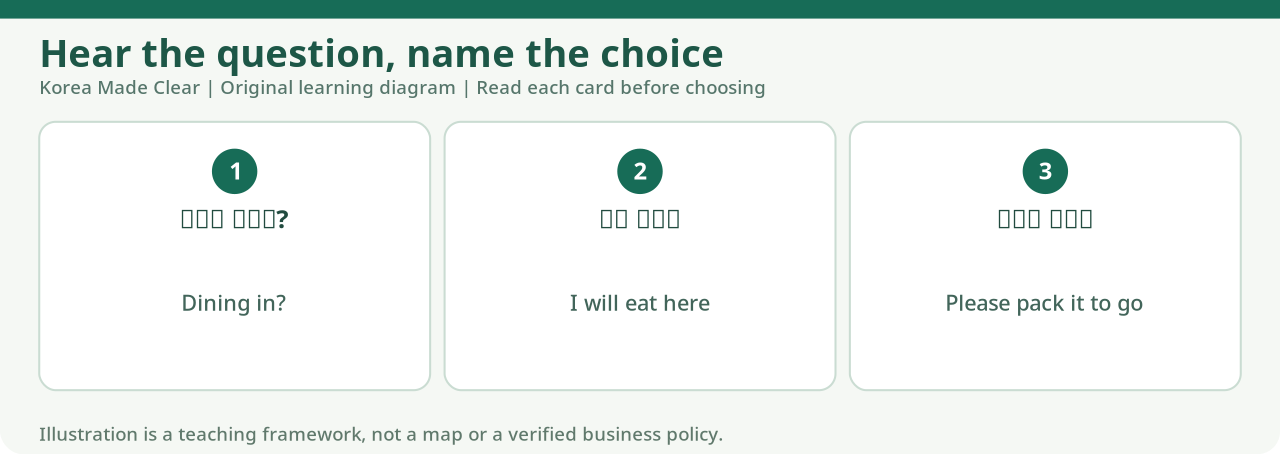
One question at checkout can change the cup, packaging, seat you use, or even where your order is handed over.
You have almost finished ordering. The cashier asks a sentence you did not expect: 드시고 가세요? The words come quickly. You nod because you think the order is complete, but the staff member is actually asking whether you will eat here. It is a small choice, yet one that can lead to the wrong packaging or an embarrassing seat search if you answer without understanding.
This lesson teaches the two service choices, several natural variations, and a confirmation step. It deliberately avoids promising that every shop has the same dine-in policy, packaging charge, or seating arrangement.
The two answers to remember
| When you want… | Korean | Practical English |
|---|---|---|
| To eat or drink on the premises | 먹고 갈게요. | I'll eat here. |
| To take the order away | 포장해 주세요. | Please pack it to go. |
| To be more explicit about the premises | 매장에서 먹을게요. | I'll eat in the shop. |
| To correct a misunderstood choice | 아니요, 포장할게요. | No, I'll take it away. |
Pronunciation cues (approximate Revised Romanization): 먹고 갈게요 — meokgo galgeyo; 포장해 주세요 — pojanghae juseyo; 매장에서 먹을게요 — maejangeseo meogeulgeyo; 아니요, 포장할게요 — aniyo, pojanghalgeyo. The Korean text is the reliable form; these spellings are only memory aids, not a substitute for listening practice.
A staff member who specifically says 드시고 가세요? is asking about eating here, not explicitly presenting both options. You might also hear 여기서 드실 거예요? (Will you eat here?), 드시고 가세요? (Eating here?), 포장이세요? (To go?), or 매장에서 드세요? (Are you dining in?). The grammatical forms differ, but the service choice is the same. A rushed 네 (yes) without knowing the question can lock in the wrong option.
Eat here is often phrased 먹고 가다 (literally 'eat and go') or 드시고 가다 in restaurant usage; it is not the same as 포장하다, to package for takeaway. When someone asks 드시고 가세요?, the intended question is whether you will eat there before leaving. This is a pragmatic service expression, not a literal English word-by-word analysis.
Listen for the question before you answer
Some staff use one sentence; others offer two alternatives in the same breath: 드시고 가세요, 포장이세요? — Eat here, or takeaway? If you hear only 포장, do not guess whether the cashier is asking about a bag, a takeaway request, or the entire order. A useful clarifier is:
매장에서 먹는 거랑 포장 중에 고르는 건가요? — Am I choosing between dining in and takeaway?
That full clarifier may be too long for a first-day traveler. The shorter and often more effective method is to give the desired answer immediately: 여기서 먹을게요 or 포장해 주세요. If you are not certain what the staff member heard, repeat the choice and wait for confirmation.
Scene 1: a café with seats
An invented dialogue for study, not a real café's official policy.
Barista: 드시고 가세요?
Are you having it here?
Customer: 네, 여기서 마실게요.
Yes, I'll drink it here.
Barista: 네, 잠시만 기다려 주세요.
Sure, please wait a moment.
Notice that 마실게요 means I'll drink it, which may be more precise for a café beverage. For food, 먹을게요 is the default. 먹고 갈게요 is a common practical answer that the barista will understand for either food or drink in a dine-in context.
This exchange does not say that an available table has been promised. At a crowded venue, ask 지금 앉을 자리 있나요? (Is there somewhere to sit now?) or follow the venue's waiting rule. Some cafés require one drink per person, reserve areas for customers, or offer different ways to collect orders. Read the actual signs.
Scene 2: a takeaway bakery order
Staff: 포장이세요?
Is it to go?
Customer: 네, 포장해 주세요.
Yes, please pack it to go.
Staff: 네, 준비해 드릴게요.
Okay, I'll get it ready for you.
At some bakeries the staff pack the items; at others you choose bread with tongs and pay at a counter. 포장해 주세요 does not mean you can enter a staff-only packaging area or demand a special container. If a bag or additional packaging has a fee, the amount should be confirmed before payment.
Scene 3: you need to correct a mistake
Staff: 포장으로 준비해 드릴게요.
I'll prepare it for takeaway.
Customer: 죄송한데, 매장에서 먹을게요. 바꿀 수 있나요?
Sorry, I'd like to eat here. Can it be changed?
Staff: 네, 아직 가능해요.
Yes, it's still possible.
A different cashier may answer 이미 준비해서 어려워요 (It's already prepared, so it is difficult). The example deliberately shows a change is sometimes possible—not guaranteed. A change to the order may affect a receipt, cup type, or packaging, and it may require waiting. Do not assume free replacement or a refund after production has started.
Cups, seats, and bags: three separate questions
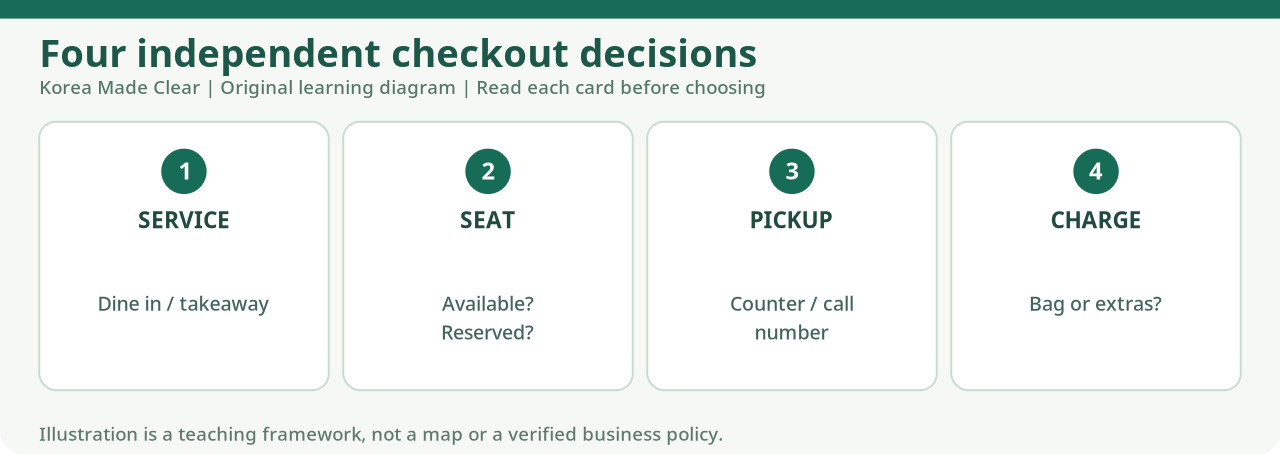
A cup is not a seating permit. A venue may give a reusable cup for dine-in, a takeaway container for carryout, or the same drink presentation for both. There is no universal cup rule applicable to every venue and date. Staff or a kiosk may request a 매장 / 포장 choice even when the item looks identical.
A seat is not part of every purchase. Some counters operate as takeout-only, while others provide limited tables or a separate seating floor. If in doubt ask 여기서 먹어도 되나요? (May I eat here?) or 자리 이용할 수 있나요? (May I use the seating?).
Packaging and bag charges are independent. The words 봉투 (bag), 포장 (packaging/takeaway) and 추가 요금 (extra charge) describe different matters. Staff can clarify whether a bag is included, separately charged, or unavailable. Rules about single-use materials may be affected by local regulation and company policy; check the posted policy, not assumptions from another visit.
Two-minute practice
A. A barista asks 드시고 가세요? and you want to sit inside. Answer 네, 여기서 마실게요 (Yes, I'll drink it here).
B. You want your snack packaged to carry outside. Answer 포장해 주세요 (Please pack it to go).
C. The staff repeats 포장이시죠? (To go, right?) but you want to eat in. Say 아니요, 매장에서 먹을게요 (No, I'll eat here).
D. There is nowhere to sit. Does answering 먹고 갈게요 create a right to a table? No. Ask about available seats or the queue.
E. A kiosk displays 매장 and 포장. These are dine-in and takeaway. Choose the appropriate one before tapping pay; check the receipt if possible.
Language note: why a literal translation can go wrong
English often uses “for here” and “to go” as short labels. Korean staff may ask a verb-based question rather than saying only those labels. The phrase 드시고 가세요? combines the honorific verb eat/drink with go/leave as part of a conventional service choice; its ordinary meaning is Are you eating here?, not Are you taking it away? The separate common choice is 포장이세요? or 포장해 드릴까요?. When learning, attach the whole phrase to a real situation instead of translating 가다 in isolation.
This also illustrates why automatically translated kiosk screens need confirmation. A machine translation may render 먹고 가다 word for word and leave visitors unsure. The most dependable response is the short sentence naming your intended service, followed by confirmation before payment.
Pocket card for checkout
드시고 가세요? (deusigo gaseyo?) — Are you eating here?
먹고 갈게요. (meokgo galgeyo) — I'll eat here.
포장해 주세요. (pojanghae juseyo) — Please pack it to go.
바꿀 수 있나요? (bakkul su innayo?) — Can it be changed?
자리 있어요? — Is seating available?
감사합니다. — Thank you.
Sources, method, and boundaries
[1] National Institute of Korean Language, Korean-English Learners' Dictionary, official learner dictionary for the verbs 먹다, 가다, and 포장하다. Use live search for the latest precise entries; this article does not attribute one café's policy to the dictionary: https://krdict.korean.go.kr/eng/mainAction
[2] Online King Sejong Institute, official beginner Korean-learning and pronunciation portal: https://www.iksi.or.kr/lms/main/main.do?lang=EN
[3] Korea Tourism Organization, independent 2026 café/dessert guide showing that menu items, servings and service formats differ across venues; it is not a nationwide dine-in rule: https://english.visitkorea.or.kr/svc/contents/contentsView.do?vcontsId=1574161
Editorial method: Scenarios are original and fictional, checked 30 October 2026. No chainwide packaging, seating, refund, tax or payment-policy guarantee is made. Independent Qwen review and GPT adjudication pending; not published.