Free · South Korea
Could I Have a Receipt? Keeping the Right Proof of Payment in Korea
One short Korean sentence can make a confusing checkout much easier to verify.
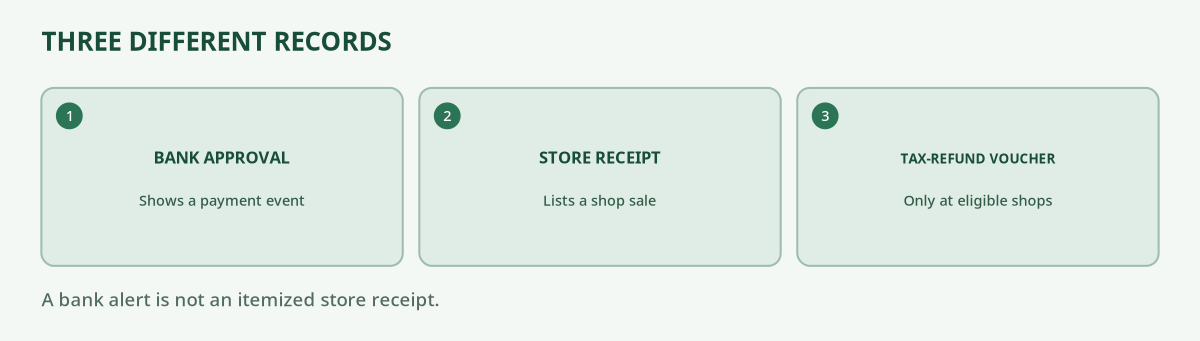
The card terminal beeps, the screen flashes, and the clerk is already greeting the next customer. You start to walk away, then wonder whether you should have kept something. Was that number the total you paid? If you need to exchange the item later, can you show the charge? A card notification may help, but a message from your bank is not always the same as the store's itemized sales receipt.
A practical learner does not need to memorize a receipt law to handle this. You need to ask for the record, check the amount, and keep the appropriate proof without handing your phone or card to strangers. The first Korean phrase is:
영수증 주세요. — Could I have the receipt, please?
It is brief, routine and polite in everyday service contexts. A fuller version is 영수증을 받을 수 있을까요? — Could I receive a receipt? Both ask for information. Neither guarantees the shop will print a new copy later.
First distinguish the three things on the screen
A payment approval (승인) is a confirmation from a payment route, which can appear on a terminal, a bank notification or a card statement. A store receipt (영수증) records a sale and may include item names, quantities, discounts and the merchant's details. A tourist tax-refund document is a different document issued only through a participating arrangement when eligibility conditions are met. One does not automatically substitute for another.
A payment app may show a pending authorisation. A small shop may provide a simplified paper receipt. A kiosk might let you choose a digital or printed record. These are examples, not universal rules for every Korean business.
Six useful phrases at the counter
| Korean | Approximate reading | Functional English |
|---|---|---|
| 영수증 주세요. | yeongsujeung juseyo. | A receipt, please. |
| 종이 영수증으로 주세요. | jongi yeongsujeungeuro juseyo. | A paper receipt, please. |
| 영수증을 다시 받을 수 있을까요? | yeongsujeungeul dasi badeul su isseulkkayo? | Could I get the receipt again? |
| 금액을 확인해 주시겠어요? | geumaegeul hwaginhae jusigesseoyo? | Could you check the amount? |
| 결제됐나요? | gyeoljedwaennayo? | Did the payment go through? |
| 이 물건이 영수증에 있나요? | i mulgeoni yeongsujeunge innayo? | Is this item on the receipt? |
The cues are memory aids, not phonetic transcriptions. 영수증 means receipt; 금액 means amount; 결제 refers to payment. The National Institute of Korean Language's Korean-English Learners' Dictionary can be searched using those exact Hangul words. [1]
Notice that 다시 받을 수 있을까요? is a request for a replacement record. If the shop cannot reproduce it, do not treat that as proof the original transaction was dishonest. Ask how the transaction can be located, perhaps using the order number or purchase time—not by dictating your full card number aloud.
Scene A: a jacket and a disappearing screen
An invented training exchange; it describes no particular retailer's actual procedure.
Customer: 영수증 주세요.
Could I have a receipt?
Clerk: 문자로 보내 드릴까요?
Shall I send it by text?
Customer: 종이 영수증으로 주세요.
A paper receipt, please.
Clerk: 네, 잠시만요.
Of course, just a moment.
The clerk offers a text receipt. If you do not want to share a phone number, you can request paper. Staff may not be able to provide every format; ask which record is available rather than assuming a store-wide policy. If you choose an electronic receipt, confirm its destination on your own device and avoid exposing sensitive personal information to people in line.
Scene B: the total looks wrong
You selected one scarf priced at 19,000 won and a pair of socks priced at 6,000 won. Without a discount or other fee, the illustrated subtotal is 25,000 won. These are invented teaching amounts, not quoted current Korean retail prices. A display showing 31,000 won should prompt a question, not an accusation.
Customer: 죄송한데 금액을 확인해 주시겠어요?
Excuse me, could you check the total?
Clerk: 어떤 부분이요?
Which part?
Customer: 이 물건이 두 개로 찍혔어요.
This item was recorded as quantity two.
If an extra item was counted, the clerk can investigate against the register. If a correction requires a refund and a new charge, ask what is being reversed and what will be charged. A bank alert alone may not distinguish a pending authorisation from a settled debit. Retain both records until the actual result is clear.
Scene C: paying cash in a small market
Customer: 영수증 받을 수 있을까요?
Could I have a receipt?
Vendor: 간이 영수증만 드릴 수 있어요.
I can only give you a simplified receipt.
Customer: 네, 그것도 괜찮아요.
That's fine too.
Do not confuse 현금영수증, a specific Korean cash-receipt system that can involve a designated identifier for domestic tax reporting, with an ordinary handwritten or printed record of a cash purchase. A visitor who simply wants the price and item proof can request 영수증 without assuming they qualify for every domestic tax-reporting feature. You do not need to disclose a local tax ID or a stranger's phone number to practise receipt vocabulary.
The thirty-second departure check
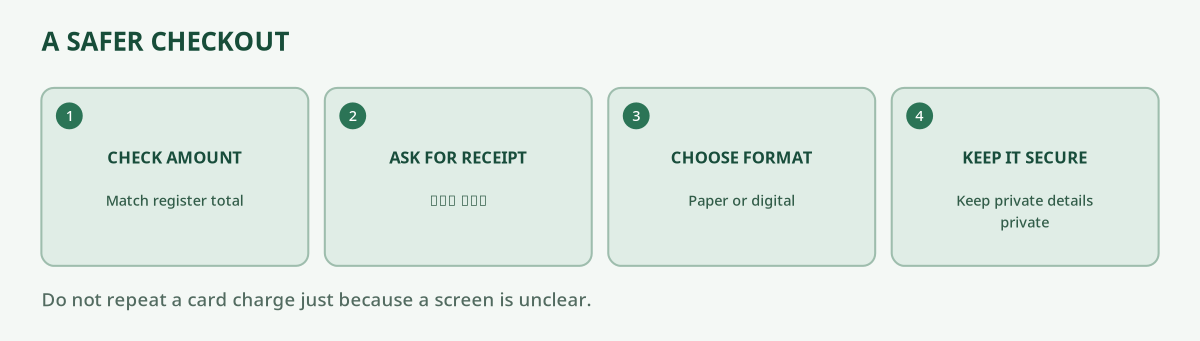
Before leaving, find the item, quantity, date and amount on the record if the shop provides them. For a valuable item, keep the receipt and the shop's separately displayed returns or exchange policy; possession of a receipt does not itself establish a universal right to return goods. For a disputed duplicate charge, preserve the merchant's receipt, payment time and the card issuer's transaction reference without showing strangers your complete account details.
If you plan to claim a tourist tax refund, do not assume the ordinary receipt is enough. VISITKOREA distinguishes regular store receipts from documents and eligibility checks for participating Tax Refund locations; this article's next lesson on tax-inclusive pricing explains the difference. [2]
The essential habit: ask 영수증 주세요, verify the total, preserve only what you need and let the merchant clarify any mismatch. A receipt is useful evidence; it is not a diagnosis of a business or a promise of a refund.
Primary sources and editorial limits
[1] National Institute of Korean Language — Korean-English Learners' Dictionary: search 영수증, 결제, 금액, 승인, 다시. It documents word meanings, not private store procedures.
[2] Korea Tourism Organization — Duty Free & Tax Refunds, last updated on its page in 2025; explains why a designated tax-refund slip differs from a general merchant receipt and is subject to eligibility. Verify the latest rules at time of purchase.
All prices and conversations in this guide are constructed examples. Actual checkout services, record formats, return conditions and card settlement depend on the merchant and payment network. This is language guidance, not legal, tax or financial advice.